I promised a post for the readers with already standing structures. That would be the majority of us, I’m sure.
But I have to start with a little highschool science lessoning, or much of what I am going to tell you won’t be adaptable to your situation. I want to push a new mantra at ya too: Insulate Insulate Insulate!!! More on that shortly, first the lesson.
AIR is a great insulator, seriously crappy conductor. In the Electronic world there is a term “air gap insulator” and it takes huge power or high frequency to bridge the gaps, more so as the gap widens. Now, thats not to say air won’t conduct ‘heat’. We heat air and move it around in our ‘modern’ homes enough that it is considered a conductor. Only that isn’t correct thinking. Its a transporter, It does pick up temperature differences and can be used to relocate that difference to somewhere else, but it does not do so willingly.(in the out of doors, we call this ‘wind’: just mama nature moving things around, the same way we do indoors.) And there really is no difference between ‘hot and cold’, except in degrees, and we call those differences degrees for a reason. Hot is just an absence of cold, or to put it another way, Hot is just a higher energy level than Cold. Those ‘degrees’ of difference are what we want to capture, store, and move around, or isolate from so we don’t require mad levels of energy to remove that higher energy level. (Do you see the problem of modern homes now? That last statement says it all.)
Termperature energy moves through three methods: Conductive, Radiant, and convective. Conductive requires ‘contact’. Radiant is what you get sitting next to a fireplace, and Convective is in air movement (heat rises, cold falls, or specifically, the density of the warm/cold object changes and is effected by gravity differently.). Its why a room can be cold and hot at the same time; hot at the ceiling, cold on the floor.
Now, I don’t know how your current structure is set up, but I can make some assumptions from the last 50 years of building code. Stick frame home, some sort of sheeting on the outerwalls, rafters of 2×6 lumber (not timbers) and a sloped roof using similar lumber covered in 3/4’ sheeting (or that 13/16” particle board popular lately). Actual roofing could be asphalt shingles, tin/sheetmetal, some sort of tile etc. BUT, there is likely one constant in that factor. THE INSULATION. More than likely the ‘pink stuff’ if your home is older than 30 years. Might be blown in, or laid blankets, could possibly be the Polyurethane stuff but thats more recent and mostly in walls. Chances are, that insulation is ONLY in the ceiling joists, not up in the rafters. And thats a problem. One addressed by vents and ventilators, and my all time favorite “Ridge vents”, (yes, there is some snark in that statement.)
What this does, and you may not have thought about it, but you HAVE experienced it, is it creates a solar oven right on top of your home. Solar ovens heat or COOL by what energy differential they are exposed to. You can use a solar oven at night to make ICE from less than freezing conditions. Many people are not aware of that. This is great when you want to cool your house down on hot nights, but not so much when you are trying to KEEP a house cool on scorching days. That insulation just laying up there in the attic joists slows the heat transfer into the living areas, but it can not stop it. Recall I mentioned the term ‘Thermal Creep’ in my post on Mud castles? Same thing applies here, the dead air spaces in the insulation don’t readily move the heat around, but it DOES move through the medium. (and thats why you want thick walls in a Cobb styled home. To ‘time’ that creep for proper parts of the day.)
Vents help keep that solar oven’s effeciency low, but they don’t all work as well as you might like. RIdge Vents in particular; and this is my opinion, I am no engineer, but experiance tells me that ‘Those don’t work!”. Let me clarify why I say that, and see if it meshes with anything you may have seen. When I had my home in Sin-Sin-Nasty, we had a new roof put on, and chose to run with the Ridge Vents, thinking it would help pull the heat out of the attic better. What we found was our electric bill went up about 10% instead. Our HVAC was working even harder after the vents were installed. What happens (purely emprical thinks here, no math on my part) is that the shingles heat up, and create convection currents up the roofline. Where is that ridge vent located? Right at the top on the peak and right inline with those HOT currents of airflow. They are literally pumping hotter air into the attic space, NOT pulling it out. On.windy days, they may actually work like they were designed, that whole venturi effect thing happening, but on still days, with the laminar flow of air along the roof, BAM! More heat, and your hovel is getting COOKED.
IF you have ridge vents, don’t freak out, there is a solution to make them work, its not highly expensive, though it does require some labor (all of this stuff is labor intensive: anytime you are trying to compensate for engineering failures gets labor intensive.). You know that mylar coated bubble wrap they sell at the local brick and mortar place? Yeah, that stuff. What you will want to do is get in the attic (early spring or late fall when you aren’t cooking your brainium) and staple that to your ROOF JOISTS, not the sheeting that makes up your roof. You want that barrier between the attic and the roof as its going to be doing some work for you. Don’t put the stuff all the way down to the soffit, you want about 6” of joist exposed down there. You DO want the barrier to lap the ridge though. What this will do is reflect the heat from the roof back at the roof, and it will create a heating area that creates a pressure differential to force that hot air out that vent, When the pressure differential favors the heat outside over the inside, it creates a space between your living quarters and the roof, slowing that radiant exchange that cooks the attic. With that gap at the soffit area, any cooler air (cool air falls) has somewhere to go and its nearer the outer walls where it can be drawn off. This might only gain you a small percentage in difference, but even a few degrees difference in the living quarters will be noticeable; especially in how hard your climate controls work.
For further assist, you can do that HOT Stand pipe thing I mentioned in an earlier post. (south-southwest facing wall for maximum effect at the hottest part of the day.) This is just a metal pipe 4-8” diameter, painted ultraflat black for maximum heat absorption. This will have a duct into the house that draws off air from the interior. You can duct this to the attic, or you can duct it to the living spaces, your call, I suggest living spaces myself. FYI,, that duct work needs to be at the higher part of wherever you run it. Ceiling in living areas, peak of the attic,,, you get the idea.
BUT, that pipe doesn’t work alone. You want to draw in cooler air while you pump out the hot. This is where basements and crawl spaces come into play. You can put a floor vent in and cooler air is drawn in as the air in the pipe gets heated up and expelled out the top. I suggest putting the floor vent at the opposite end of the house so you get a draft effect. I would also suggest having some way of shuttering BOTH the vent and the ceiling draw as at night, that air flow WILL reverse direction. One scorchers, this is a plus, in winter months, bad ju-ju.
Another thought: A small 10watt solar panel powering a fan in the soffit. When the sun is shining, it will power that fan to push air INTO the attic,,, That may be enough pressure difference to force the ridge vent to do it’s job. Mostly passive (still a mechanical process of moving air, so parts can/will fail eventually)
Now,,, INSULATE, INSULATE, INSULATE! I’m gonna toot my own horn here for a minute. When I built my house, I already knew the ridge vent scam and I had an idea in mind. One, I didn’t put in an attic. My ceiling is vaulted to the roof truss. I used 2×10’s not 2×6’s for the truss. That gave me MORE room for insulation. I used the 3/4 11ply sheets for the roof, thats covered in the 80# tarred felt, and on that is where my TinRoof sits. No gap between as I didn’t want to hear my roof (its sounds romantic, but try living in a tin-roofed house during a hailstorm,,,). Inside, I ran 1/4” mylar faced styrofoam boards between the joist (small air gap made by using strips of the same) and then I ran a double layer of the pink stuff in blanket form. Slightly compressed (shoulda used 2×12’s) but alternating layers so any gaps between blankets are covered by the next layer. Then the internal sheeting, which I used was 1/4″ paneling. I wanted to use the tongue and groove stuff but the costs were already reaching past my budget.
Walls I used Rockwool: at the time, it was about the same costs for sq/ft, and I wanted the fire resistance of rock wool. Its only slightly lower R value over the pink stuff, but does not give you the itchies like the pink stuff. (don’t breath any dust though, Silicosis is real.). I did not insulate my floor joists. My reasoning was “critters”. I have access to my crawlspace that critters can get into easy enough.(and try to make a place critter proof! HA!). I decided the lack was in my benefit. Just make sure to keep the air flow under the house limited.
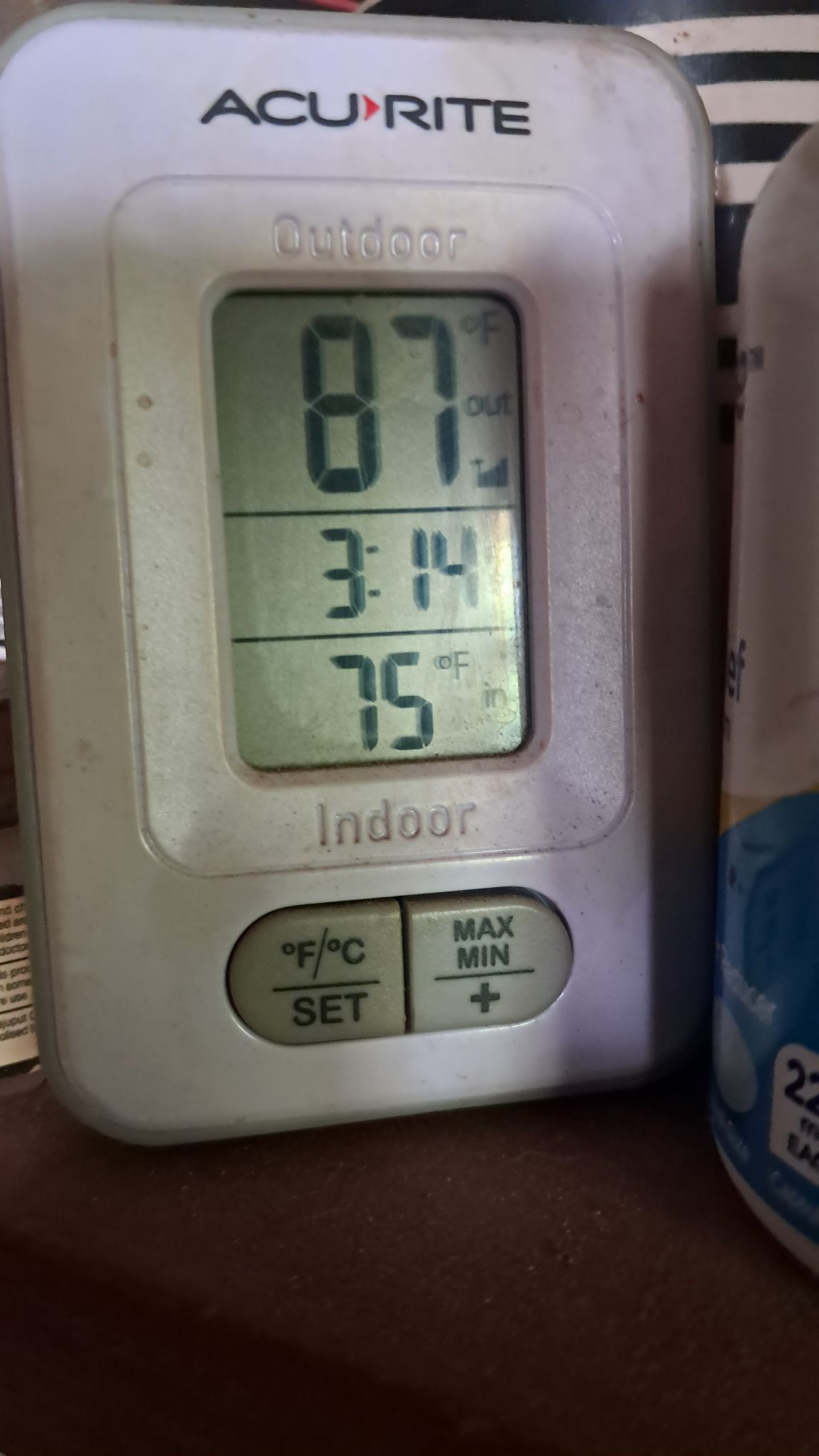
It was 90 outside at three this afternoon when I returned from the J.O.B. My interior was 71. NO A.C. My only consolation to air movement is a 12v ceiling fan that only gets turned off for cleaning.
And guess where I found the Cozzie? Right smack dab under that ceiling fan, looking quite comfortable on a hot day.
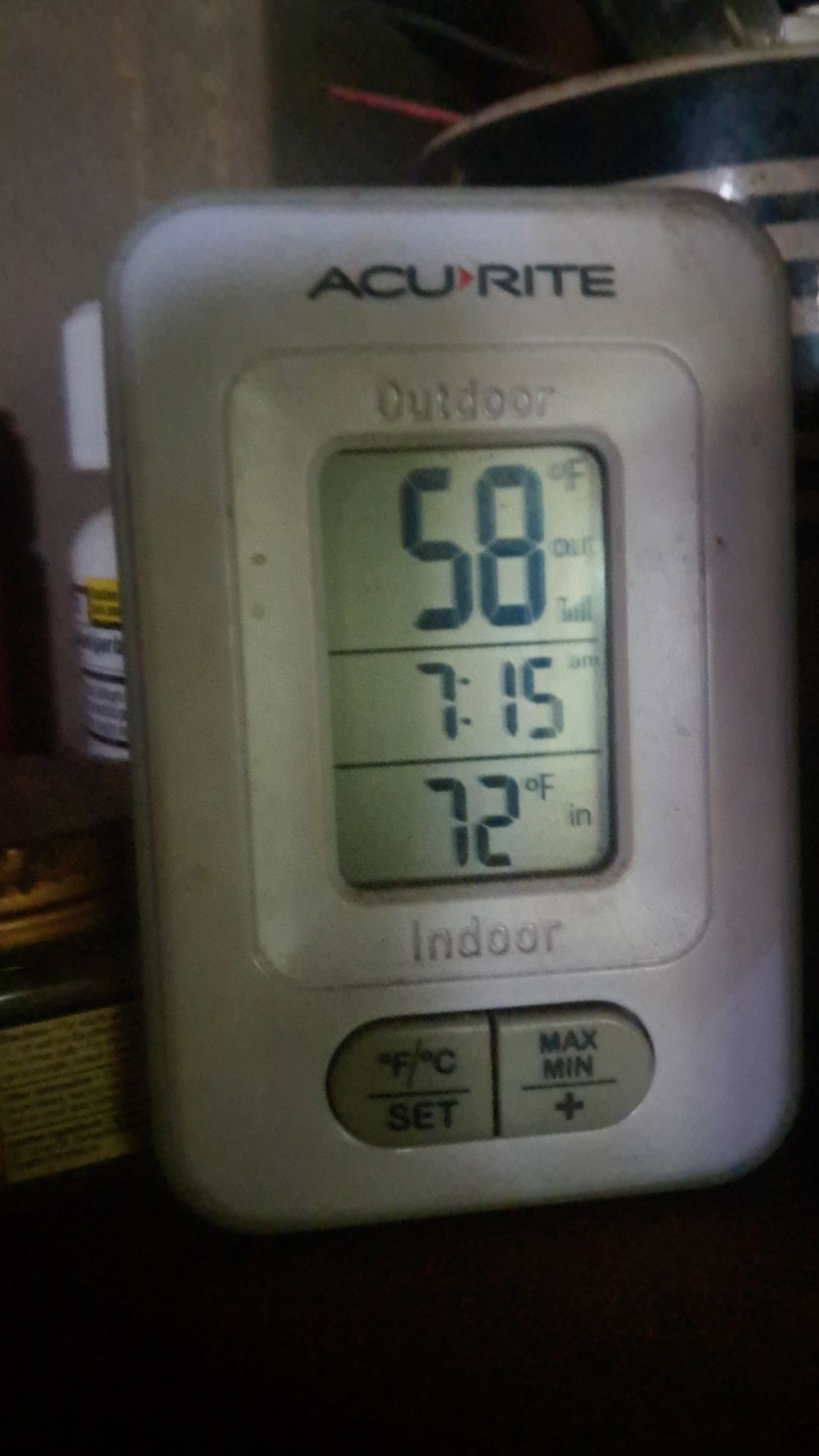
look at the time on each. steady state climate in the house over a 24 hr period. Insulate, insulate, insulate!
—————————————————————————————————–
I hope this helps some of you. I know “gotta spend money”, but hey, if it cuts your bills down enough in one season to pay for the ‘fix’, then next year, it pays for itself again, but thats money in your pocket, not the utility companies.
LIVE
LEARN
LAUGH
LOVE
LOAD!!!!

ADDENDUM: IF, like me, you are something of a music afficianado, Get over to BOM’s blog,,, jump into the conversation we have going.


Always liked Rush, meself. just sometimes not so easy to hear Geddy’s vocals for an extended time. Love their moosic tho. Being such an Olde Pharrtt, I’ve listened to most of ’em, and like ’em!
Well – guess now, I’ve gotta go back and re-listen to ’em all over again. Dam – wish I didn’t share yer semi-deafness, Bro Dio! What the hel, a good excuse (as if I needed one – LOL) to do so.
L’s!
Y’all take care,
Mike in FLA.
LikeLiked by 1 person
Yah,,, when I listen to music, so do ALL of my neighbors. Fortunately for them, my system uses more power than I like asking of my batteries, so its not a daily thing.
LikeLike