Talkin’ the rocket mass stoves here. I really think that this is going to be something of a feature in homes in the future. The downsides to it right now are that everything going into a new buildin , must be “approved” and Listed, as in UL listed or one of the other testing places. That is expensive and the real problem in getting RMH stoves tested being they are also rather ‘artsy’: each being built on site for the particular home they are going into. No one is going to build the stove then dismantle it to send it Underwriters laboratories for testing, to the tune of 25grand or more. Not each and every stove.
Luckily, there are states that are making exemptions to such things. (I don’t recall which ones, though I seem to remember one being New England: shocked I was!)
Permies has been doing research into different builds techniques and materials, and even does particulate testing on their stoves. Their stoves, again, not mass produced therefore untestable by a standards company, have been besting the EPA recommendations on orders of magnitude. EPA suggests .4% particulate matter on a running stove. Permies has been producing less than a 10th of that.
And they use 1/4 the fuel of a standard wood burner for the same result in house.
There are all sorts of reasons why some people want this style of stove. They may be buying into the Carbon Myth, wanting to reduce carbon and particulate emissions. They may be trying to do similar to me, going off grid and want as efficient as you can get. Or the other side of the coin, that I am on, wanting the heat, but no one makes a stove that fits my house. It either runs too hot, or won’t put out the heat I need and ends up creating soot issues and always ends up pumping more heat OUT of the house than what remains in.
And then there are those that just want to supplement what they already have in place to help reduce costs overall. IE A heat pump that works, but want to reduce its duty cycle and use less electricity.
https://youtu.be/QY4mnYc0Mgc?si=ZHUkt0GxPV6qlIjZ. (One the groups trying for a modular unit, no affiliation, but a good explanationof function.)
And the choices are growing fast thanks to the internet and curious kittehs like myself. Rocket style stoves (J-tube top feeding downdraft stoves) Batch style heaters (typical front loader like most accepted wood burners). Russian and Swedish styled ceramic tile stoves (similar concepts of re-routing hot gasses through a maze of brick to collect more heat for slow release)
The concept is simple. Capture as much heat as you can before it leaves the house. Thats the whole purpose of these stoves. The Rocket stoves produce incredible amounts of heat, running at peak efficiency reducing emissions to base components of CO2 and H2O with minimal particulates. They generate ash in the ash bin, and some fly ash that accumulates over time in the chambers (and why they have clean out ports.) Everything else is normal and IMO non-pollutants. (the CO2 was gathered by the trees, and will be again. Perfect circle!)
Imagine the actual fire pit being close to 2000F and by the time the exhaust gasses leave the building, they are around 100F and clear with no particulates (or nearly so). Thats 1900F thats been captured by the stove to release out over time. No need to run a fire in the stove 24-7 to keep a house almost warm. Radiant heat feels better than forced air heat (and yes, thats a subjective statement) that definitely lasts longer. Load the hopper once every 12 hours or so, burn hot and fast for a couple of hours and forget about it. Better than waking every couple of hours to feed a beast that only sort of does the trick.
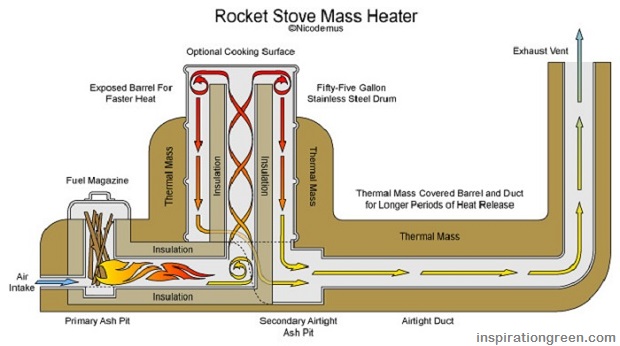
So here I am, Not in consideration mode anymore, but active ‘I’m doin’ this’ mode. But I hit a snag, one I need to resolve. Do I cut out the floor and run the stone all the way to the ground instead of ‘pumping up my floor joists’, or just reinforce. It really doesn’t make a difference in the performance of the stove, but I am thinking longevity of the building. Were I to build again, I already know, Build the base for the stove FIRST, and sort of build the house around it. Much like they used to do hereabouts. I have found three old fallen down houses built back in the early 1900’s and ALL of them had a chimney dead center of the house that went to the ground and the house was built around that. Some had two fireplaces on opposing sides, but all went to the ground.
And despite the word on the nets, all of them were built with locally gathered sandstone and slate, and only one had any firebrick in it. That fire brick was the ‘floor’ of the fireplace, No lime mortar though,,, That I can see. They did use the refractory cement over mortar except on the outside where they went with the cheaper stuff. In one case, no mortar at all: they used Cobb, clay and sand mix. And thats cheap around here if you are willing to do a little digging or swinging a shovel. River sand is very clean after a flood and usually piled several feet deep before you hit the mud. Clay is readily found near any creek, and like in my case, my house sits on a clay formation thats almost 2 feet thick and several hundred feet wide.(and it’s only 2′ down to it.) For the record: I will be using fire brick in the main combustion chamber as the temperatures get quite a bit higher than a normal fireplace would see.
Really, not counting labor times, building one of these should be doable by even the poorest of people, and work 10 times better than a UL listed store bought EPA approved steel and brick monster.
Ah, but Dio,, that means less money flowing and the money has to flow to keep the economy together.
Yeah,, that’s true, but what happens when the economy is no longer functional, but people still need to keep warm? One summer of some hard work and little expenditure but a warm house for years after, and repairs can be done the same way it was built: locally furnished material.
By the way, this is a DEEP deep rabbit hole if you start digging. Some people building J-tube rockets that don’t feed a box, but run through tunnels under the house, venting on the opposite side. The original ‘floor heating’ arrangement. (and that idea is OLD! Korea had a system like it, as did the roman bath houses.). Seriously, if you are thinking of building, consider how you want to heat and cool the house before you ever lift hammer or push saw. That will make the rest of the build so much easier, unlike where I am, thinking about dismantling part of my floor.
Go, be creative, learn something new, and fly the birds of freedom at those that want us to buy systems that need replaced every 10 years or so. (but be advised, getting homeowners insurance might be tricky!)
LIVE
LEARN
LAUGH
LOVE
LOAD

BLoo update: Good tidings at that. took her for a run Sonday to the tune of 150 miles (152 to be exact) and did a fill up on return. 9.98 gallons. 15mpg on a 25 yo SBC? No, I ain’ta complainin’! (and roughly 40 of that was here in town the day prior so its likely closer to 13/16 town/highway. Still no complaints.


Sounds very workable and, most of all, VERY efficient. I gotta admit, this Rocket heater is a new concept to me. Rocket backpack cooking rig – yeah – but not the heater part. Oughtta be a dynamite rig! Don’t tink I’ll be needin one here in FLA., though😎 Still, it’s sumthin I’d like to be more knowledgeable in.
L’s!
Y’all take care,
Mike in FLA.
LikeLiked by 1 person
I heard of some in FLA, for hot houses/greenhouses. Ran under floor the whole length, for those rare freezer nights y’all get. So even there, they have a place and purpose.
LikeLiked by 1 person
I’d agree. Still, I ain’t ded yet, and that means I gotz to know more, in lotsa subjects. Must constantly learn, I must (gotz ta keep those 2 ornery brain cells busy, dontcha know)!
L’s!
Y’all take care,
Mike in FLA.
LikeLike